Audience award

by Lachezara Yordanova
Wikipedia intriguingly describes the genre(s) of Romanian writer-director Mihai Mincan Milk Teeth (Dinți de lapte) as “political fantasy drama.” But while elements of all three can indeed be found in the film, the overall spirit is arguably more thriller-like. The suspense here is built on the principle of Chinese water-torture, a technique which kills not through strength but rather with steady consistency.
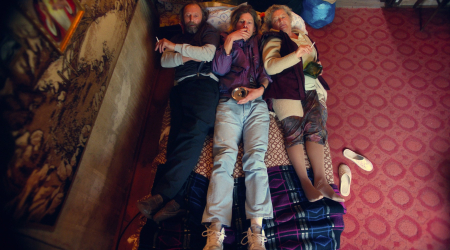
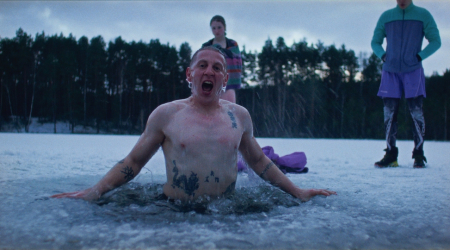
Shots often mimic documentary through the frequent use of camera movement; the camera is often very close to the performers' faces, and traditional rules of "well-balanced" composition are frequently flouted.
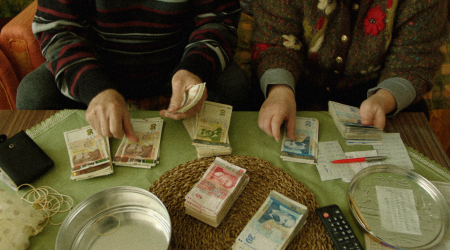
Such arresting techniques are placed at the service of a highly dramatic plot. The trigger for events is a crime which takes place during a period of political uncertainty, namely the Romania of the late 80s during which Communist dictator Nicolae Ceaușescu was ultimately overthrown and soon after executed.
The focus is on one family enduring unbearable stress: the elder of two sisters, Alina (Lara Maria Alexandra Comanescu) has apparently been kidnapped; after all investigations provide fruitless, only her sibling Maria (Emma Ioana Mogos) keeps digging on her own...
Cinematographer George Chiper-Lillemark translates the prevailing mood of uncertainty through his visual language. Light thus becomes a prominent character thanks to the moments when it either prominently shines through the images or completely vanishes.
Regarding the possible “fantasy” elements, there are three particular points in the story which justify this. While most of the aesthetic looks realistic, these segments aim for an enchanted or horrifying sensation. At one point Maria leads kids from the block to an abandoned construction building where they come across a Slender Man–resembling figure. That event shifts the story away from its realistic tone towards more supernatural zones.
Horror vibes meanwhile infuse a scene which takes place in a photographic lab. A photographer comes under suspicion (for the viewer) simply by the way she is presented, suffused in red lighting before disappearing into the shadowy void of the room. Maria, witnessing this, quickly runs away; she squeezes what looks like a glowing walnut, which only resumes its natural form when she is safe at home.
Nicolas Becker's sound-design, meanwhile, relies heavily on specific details. It plays well with silence, and effectively foregrounds subjective experiences such as a racing heartbeat, or laboured breathing. Overheard radio-broadcasts subtly underline the political dimension and background. Woven into the background as noise to which no-one really pays attention, they unobtrusively illustrate the collapse of an entire political system.
Back to...