Audience award
by Berina Musa
Who would have thought that the sound of a protagonist vomiting their guts out over the end credits could leave a festival audience exhilarated? Black Money for White Nights (Cherni pari za beli noshti) achieved that feat in Palić this year at the Serbian event's 33rd edition.
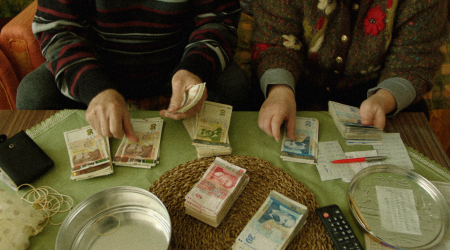
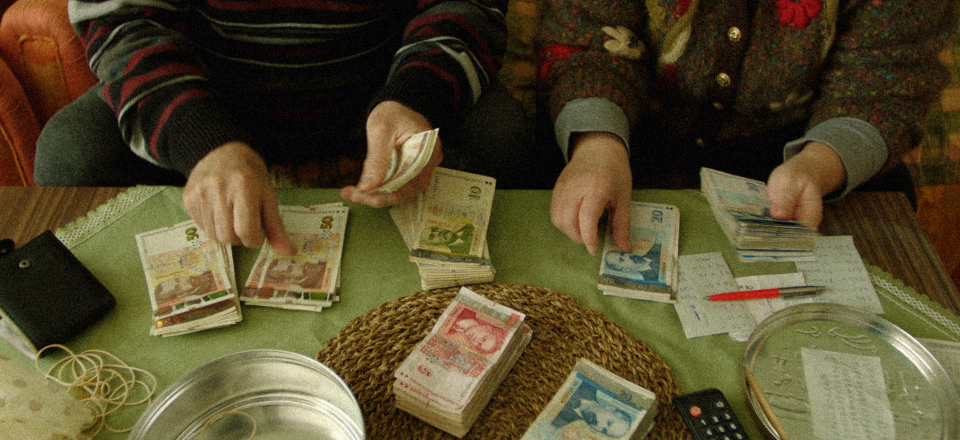
The Bulgarian-Greek dramedy follows Marina (Tanya Shahova) and Goša (Ivan Savov), a middle-aged couple whose lifelong dream is to witness the White Nights in St. Petersburg. They finance the trip with bribe-money criminally accumulated over the years, and hidden in a metal Christmas biscuit-tin. However, Russia's full-scale invasion of Ukraine in 2022 derails their travel plans, unleashing long-buried family secrets that turn their marriage into a battlefield of its own...
As the story unfolds, writer-director duo Kristina Grozeva and Petar Valchanov (working with co-writer Decho Taralezhkov) keep the audience on its toes with a steady stream of twists; some more convincing than others, but always entertaining. True to its contrast-loaded title, the film thrives on relentless conflict. Shahova and Savov carry the narrative with effortless naturalism, making Marina and Goša's dysfunctional relationship as heartbreaking as it is amusing.
This being their fifth collaboration, the directors (The Lesson, Glory, Triumph) display once again a keen eye for memorable details. A homeless Orthodox priest blessing Marina's cross-pendant and an unidentified woman staring directly into the camera with visible irritation lend the work a fleeting documentary quality. However, the standout scene demonstrates the filmmakers' mastery of tragicomic storytelling: a devastating revelation lands with impeccable comic timing, only to leave a crater of vulnerability moments later.
Occasionally, however, the film buckles under the weight of its own ambitions. Whenever the narrative abandons its present-day momentum to unearth long-suppressed conflicts and increasingly outrageous family mysteries, it drifts into cutesy melodrama. Rather than enriching its genre-bending, these detours disrupt the pacing. Likewise, the script attempts to juggle an abundance of themes — forgiveness, corruption, piety, war and peace — which leaves its episodic narrative development feeling increasingly loose and fragmented.
In the end, Black Money for White Nights suggests that it is rarely history alone that derails our lives, but the compromises we quietly accumulate over decades — and that, as the protagonists learn to laugh about their own mistakes, a sense of black humour be invaluable when dealing with the white lies we tell ourselves.
Back to...